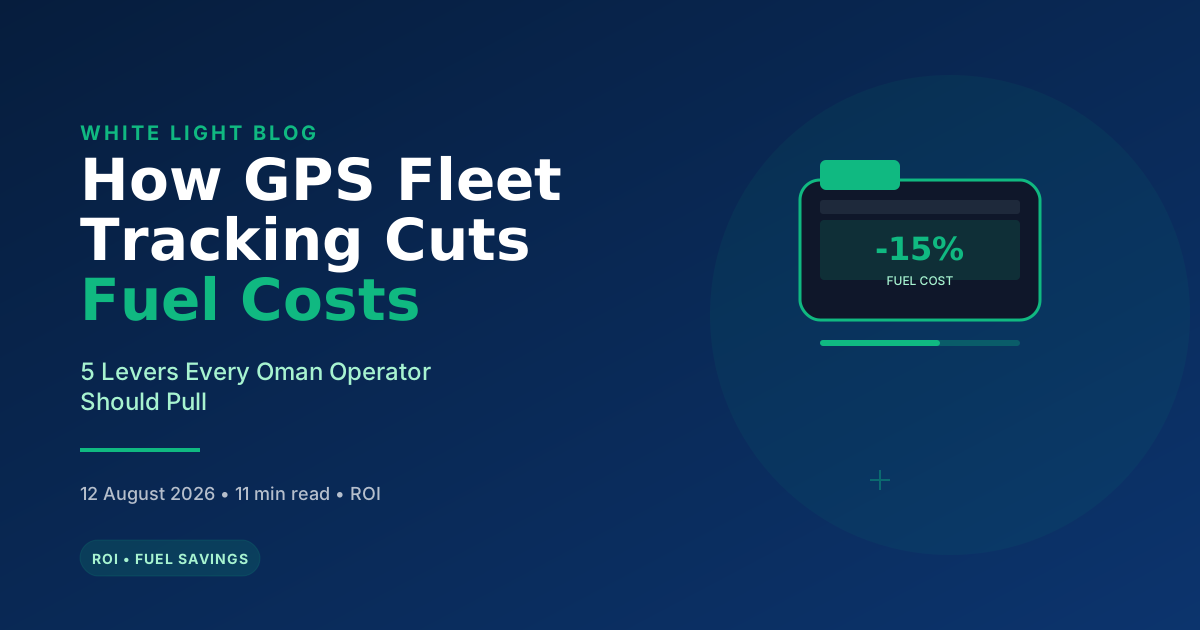
Fuel is the single largest variable cost for most commercial fleets in Oman. With long intercity routes — Muscat to Salalah is ~1,000 km, Muscat to Duqm is ~700 km — small per-kilometre inefficiencies compound fast. A modern GPS fleet tracking system, deployed with discipline, typically pays for itself in fuel savings alone within the first 12 months. Here are the five concrete levers to pull.
The Omani fuel-cost reality
Oman's fuel is subsidised but costs have risen over the past five years, and the subsidy reform roadmap is well known. For a 50-truck fleet running ~2,500 km/vehicle/month at ~0.10 OMR/km, the annual fuel spend is in the range of 1.5 million OMR. Even a 10% improvement represents ~150,000 OMR/year — multiples of any IVMS or GPS subscription cost.
Lever 1: Idle-time reduction
Fleets commonly waste 15–20% of fuel through idling — engines running while parked, queued, or waiting at customer sites. A GPS system with idle alerts surfaces this immediately. Set a threshold (say, 5 minutes), alert the driver and supervisor in real time, and add idling to the driver scorecard. Most fleets see a 30–50% reduction in idle hours within 90 days, with no operational change other than awareness.
Lever 2: Route optimisation
Oman's geography forces long routes, but within those routes there is often 10–15% slack from inefficient sequencing, missed backhauls, and unplanned detours. Dispatch tools that integrate with your GPS data — nearest-asset assignment, multi-stop optimisation, automatic empty-leg detection — directly cut km driven. Multiply by your per-km cost and you have a significant annual number.
Lever 3: Speed governance
Every 10 km/h above the optimal highway speed adds roughly 13% to fuel consumption. A fleet running 100 km/h on a 90 km/h optimum corridor burns more, arrives only marginally faster, and increases accident risk. Speed governance — real-time alerts at zone limits, automated coach-to-driver messages, and supervisor follow-up — typically reduces average speeds by 5–8 km/h, saving 5–10% on highway fuel.
Lever 4: Driver behaviour coaching
Harsh acceleration, harsh braking, and harsh cornering each waste fuel and accelerate mechanical wear. Together, they typically add 5–10% to fuel consumption on aggressive drivers. A driver behaviour scorecard — surfaced weekly to the driver, with supervisor coaching for outliers — closes this gap in 3–6 months. The data is already in your IVMS or GPS system; the work is in the coaching discipline.
Lever 5: Fuel theft and fraud detection
For fleets with on-board fuel tanks, fuel theft is a real and recurring cost — often attributed in the books to "consumption" rather than "theft". A fuel-level sensor paired with GPS data surfaces anomalies immediately: a sudden drop while parked, a drop that doesn't match any refuel record, a route that passes a known illegal siphon point. Even modest fleets recover tens of thousands of OMR/year once this is in place.
A realistic Oman case
Anonymised composite: a Muscat-based construction fleet, 40 light vehicles plus 10 heavy trucks, mixed routes within the capital and interior, baseline year of operation tracked before any GPS deployment.
- Baseline annual fuel spend: ~1.4 million OMR
- Year-1 savings after disciplined deployment: ~12% across the five levers
- Annual saving: ~168,000 OMR
- Hardware + subscription cost over the same year: ~30,000 OMR
- Net first-year benefit: ~138,000 OMR
- Payback period: ~2.5 months
Beyond fuel: the secondary ROI
Fuel is the most visible line item, but disciplined telematics typically also produces:
- Insurance premium reductions of 5–15% where insurers offer telematics discounts (less mature in Oman than in the US/EU, but growing)
- Maintenance cost reductions of 8–12% from proactive scheduling and earlier fault detection
- Productivity gains of 10–20% from better dispatch and reduced idle
- Reduced accident costs from driver behaviour coaching (often the largest single line for high-utilisation fleets)
Why the OPAL-approved vendor matters for ROI
The savings above assume clean, accurate, tamper-proof data. If your GPS reports a hard-brake event that never happened, or misses a 30-minute idle because of a coverage gap, the optimisation is built on sand. OPAL-approved IVMS vendors in Oman are required to deliver data quality, audit trails, and reporting that withstand scrutiny — which is exactly what fuel optimisation needs.
Talk to White Light
White Light has been supporting Oman fleet operators since 1997. If you want a free fuel-savings diagnostic on your existing fleet data — or a deployment roadmap for a new GPS or IVMS system — our Muscat team will run the numbers with you, transparently. Send your fleet size and current odometer readings; we will come back with a credible 12-month projection.